


소개
기본적인 기업분석을 하고 채용공고 기반으로 핵심 역량 우선수위를 추출할 때 딥리서치를 활용해보았습니다.
진행 방법
수업 때 제공한 것은 기업/산업 조사와 JD 분석에 초점이 맞춰져 있는데, 제 상황에 맞게 적용을 해보려고 "딥리서치 프롬프트 작성 도우미 (GPTs)"를 활용했습니다. 어떤 항목을 조사하면 좋을지 잘 몰라서, 수업 때의 프롬프트를 참고할 수 있게끔 복사 붙여넣기 해주었습니다. 그리고 분석 보고서에 들어갈 만한 항목을 적어서 구체화했고, 특히 output이 잘 나올 수 있게 "제미나이 활용", "어떤 형식으로 어떤 언어로 작성"해달라고 구체적으로 작성하였습니다.
요약하면,
미국(영미권) 경제학 박사 취업(tenure-track 등)을 준비하고 있으며, 학교 전반(연구·티칭·협업), JD분석(핵심업무·우대기술·면접질문), 지역환경(치안·학군·편의시설)까지 포함한 종합 보고서를 원함.
저의 연구에 대한 내용을 제공해서 해당 JD와의 핏을 판단하길 원함.
최종 출력은 Executive summary(중요 포인트는 영어), 상세보고서는 한글, 면접질문은 영어로 받길 원함.
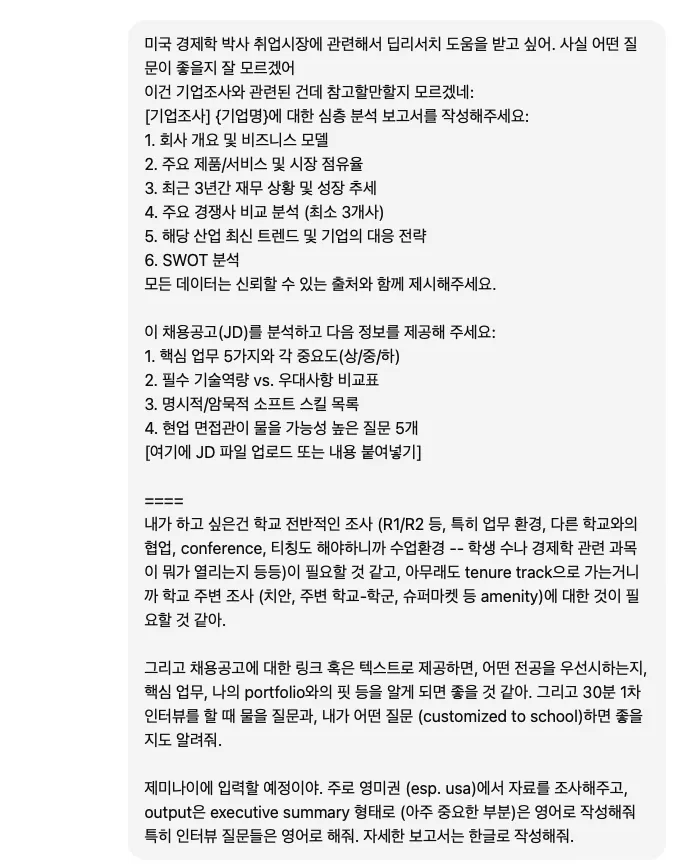
맥락 강화를 위해 추가 질문을 주었는데, (1) 우선순위와 범위, 그리고 (2) 세부 포맷, 산출물 선호에 관련한 문항들이었습니다. 결과적으로 나온 프롬프트는 다음과 같습니다.
# Title
Comprehensive Analysis of Economics Faculty Position (R1/R2 Universities, USA)

# Background
The goal is to support a PhD in Economics candidate (specialized in Public and Applied Economics) who is entering the U.S. academic job market. The focus is on tenure-track positions (primarily R1, some regional R2; teaching-focused schools excluded).
The research should deliver insights into the target school’s research environment, departmental expectations, teaching load, and surrounding living conditions. Additionally, the candidate seeks tailored analysis of job postings (JD) to evaluate fit with their research portfolio and to prepare for interviews.

# Research Objectives
1. Provide a structured overview of the target university and economics department (R1/R2 classification, faculty composition, research output, PhD placements).
2. Analyze departmental research resources and collaboration opportunities (seminars, conferences, nearby institutions).
3. Evaluate teaching expectations (course load, typical class size, types of courses offered, student demographics).
4. Perform a deep analysis of the job description (JD):
   - Extract 5 key responsibilities (with importance ranking: High/Medium/Low).
   - Create a Required vs. Preferred Skills comparison table.
   - List explicit and implicit soft skills.
   - Generate 5 likely interview questions (English, as if from hiring committee).
   - Suggest 5 candidate-driven questions to ask the committee (English, tailored to the school).
5. Match JD expectations against the candidate’s research portfolio (Public/Applied Economics, housing, labor, crime, policy evaluation using quasi-experimental & structural models).
6. Assess the surrounding area: crime/safety, housing costs, schools (K–12 quality), local amenities, commute.
7. Summarize university financial health and trends over the last 3 years (budgets, research funding, student enrollment).
8. Deliver both:
   - Executive Summary (English, 1 page, simple language suitable for interview prep).
   - Detailed Report (Korean, structured with tables/sections).

# Scope
- Universities: R1 primary, regional R2 secondary (exclude teaching-only schools).
- Geography: United States.
- Timeframe: Last 3 years of data (research output, finance, crime statistics, placements).
- Sources: Official, verifiable (university pages, IPEDS, Carnegie Classification, AEA, NBER, RePEc, FBI/City-data, Zillow, GreatSchools, Chronicle of Higher Education).

# Methodology
- Collect official data from institutional repositories (IPEDS, CDS, Carnegie, FBI, Census, Zillow).
- Extract JD text and apply keyword analysis (TF-IDF, frequency counts).
- Compare JD requirements with candidate’s portfolio using keyword matching (Public Econ, Applied Econ, quasi-experimental, structural modeling).
- Compile standardized comparison tables and scorecards (0–5 scale for environment metrics).
- Annotate all findings with numbered references; provide a References section at the end.

# Key Areas of Investigation
- Department Overview: R1/R2 classification, faculty size, PhD placements.
- Research Environment: publications, funding, seminars, collaborations.
- Teaching Environment: course offerings, class size, teaching load.
- JD Analysis: responsibilities, skills, interview prep.
- Fit Analysis: JD vs candidate’s portfolio.
- Surrounding Area: safety, housing, schools, amenities.
- Financial/Institutional Health: trends and sustainability.

# Expected Outcomes
- Executive Summary (English, 1 page).
- Detailed Report (Korean, sectioned with tables and figures).
- Interview Preparation Package (English Q&A: committee questions + candidate questions).
- References section (numbered, with URLs).

# Resources
- University official websites (department, HR, course catalog).
- IPEDS, Carnegie Classification database.
- AEA Job Market listings, Chronicle of Higher Education.
- NBER, RePEc, Google Scholar.
- FBI Uniform Crime Reports, Census Bureau, Zillow, Redfin, WalkScore, GreatSchools.
- University annual financial reports.
딥리서치로 넘어가서, 저는 현재 채용공고로 나왔으면서 저의 핏에 잘 맞다고 판단되는 학교로 실습해보았습니다. (물론 이번 해에 지원하지는 않겠지만요ㅎㅎ) 시간은 10-15분 정도 소요된 것 같고 docs로 제공받을 수 있어서 좋았습니다. 제가 원하는 포맷으로 제공을 해주어서 매우 만족했습니다 (너무 길어서 첨부하지는 않겠습니다). Infographic 기능을 살펴보았는데, 한 눈에 보기 좋았습니다!
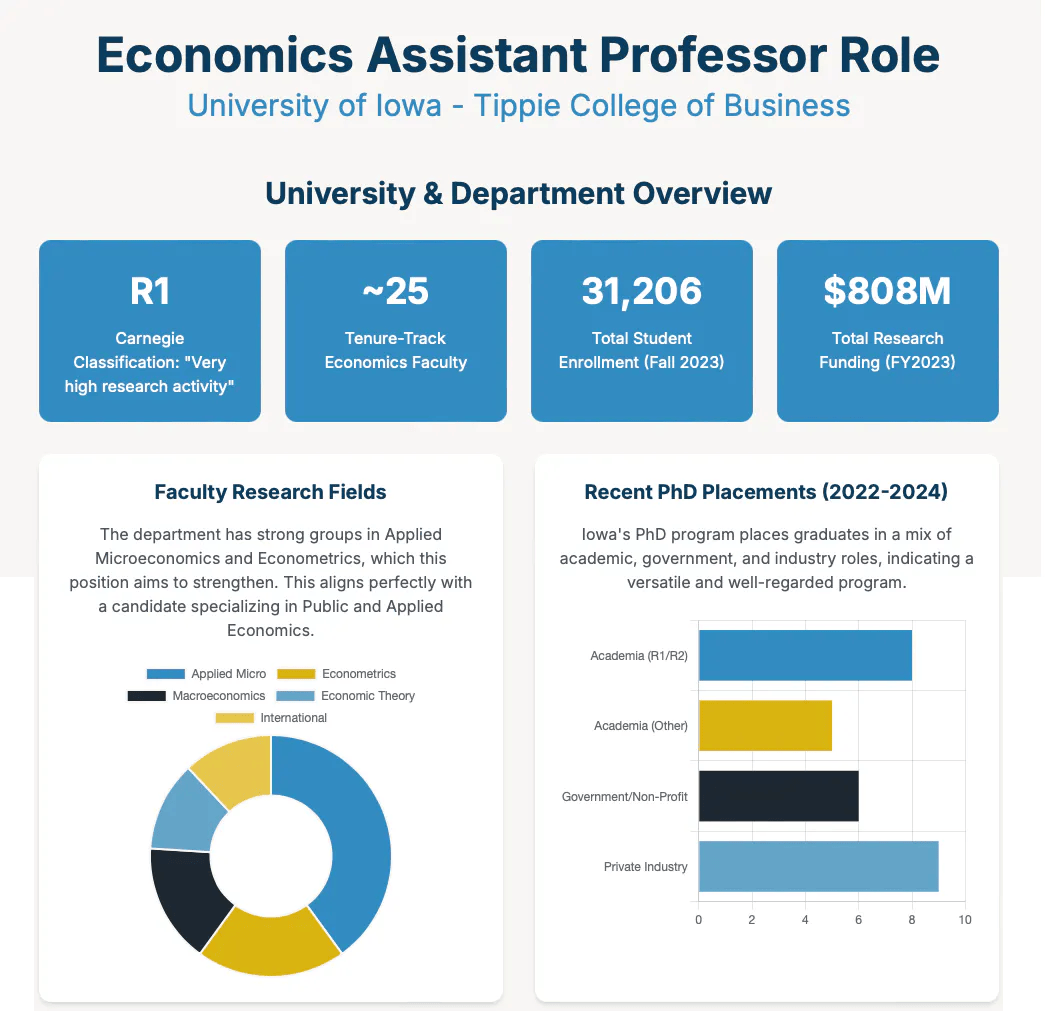
가장 중요한 리서치 티어 (얼마나 연구 중점적인 학교인지), 연구 환경, 그리고 교수진들의 필드를 한 눈에 볼 수 있어 좋습니다.
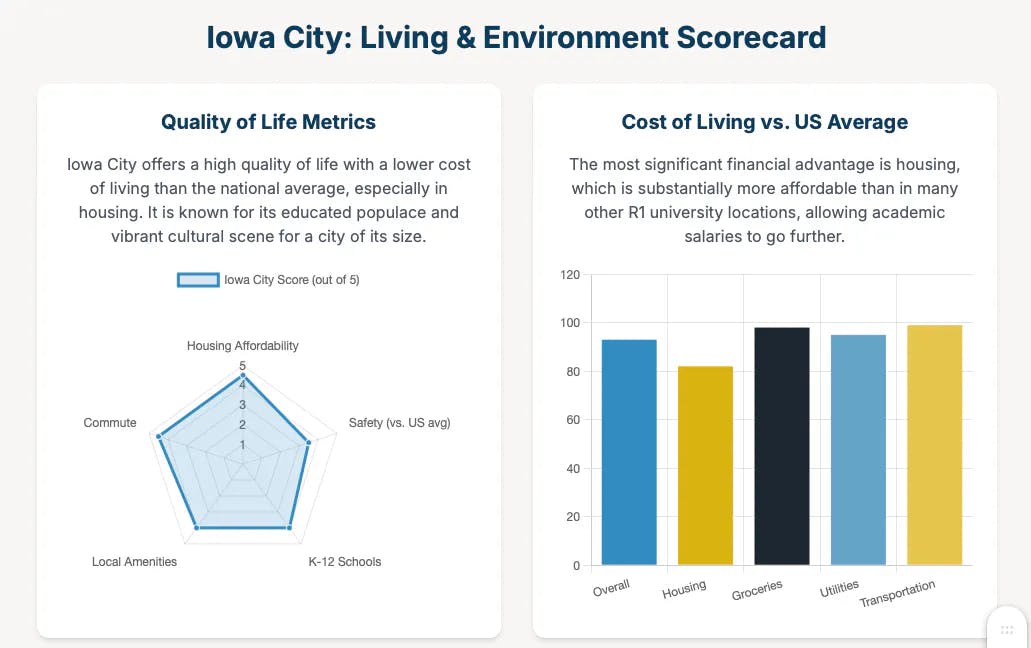
저의 우선순위에서 연구 환경 다음으로 주거지 환경을 설정했는데, quality of life metrics를 잘 보여주었습니다. 특히 임금 대비 주거비라든지, 얼마나 안전한지, 학군은 어떤지 등에 대해 잘 대답해주었습니다.
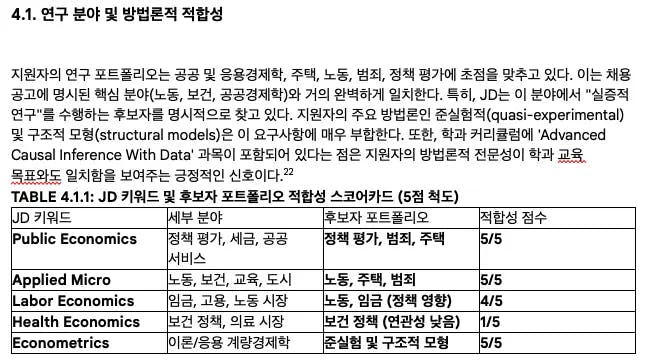
인포그래픽스에는 나오지 않았지만, 저의 리서치 핏과 채용공고가 얼마나 일치하는지도 알려줍니다. 채용공고에 나온 키워드를 위주로도 적합성을 알려주지만, 학과 커리큘럼 과목도 찾아서 인용해주어서 더 좋습니다.
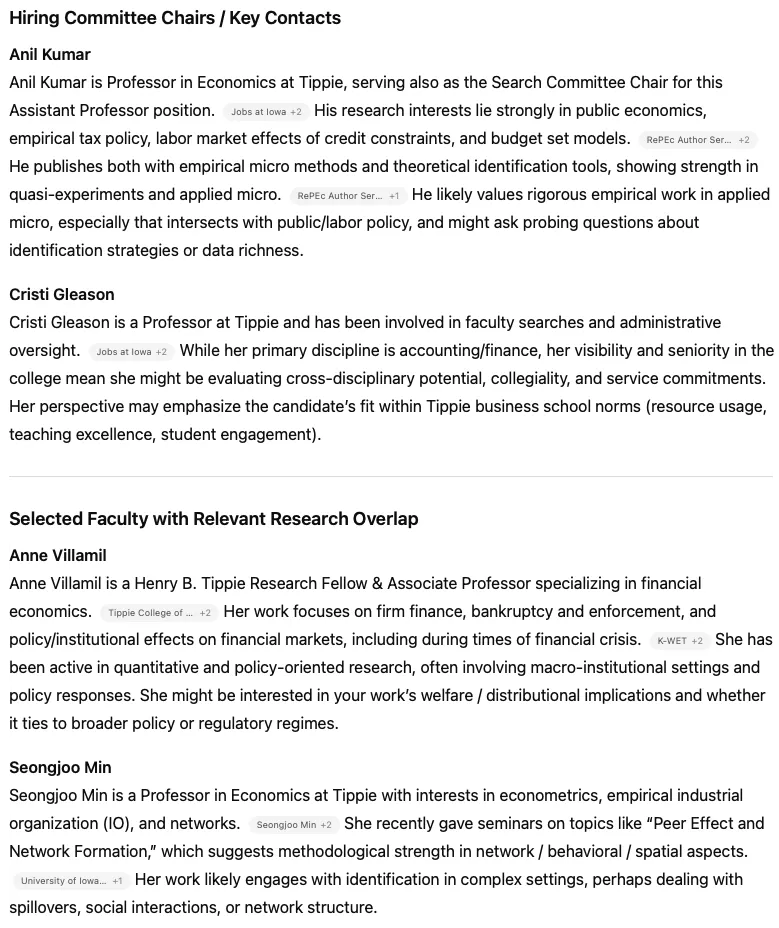
리포트를 읽다보니, Flyout/1차 인터뷰 대비용 교수진(특히 Hiring Committee + 주요 Faculty) 정보 요약이 필요할 것 같아서 추가 요구사항을 넣어 프롬프트를 확장하였습니다. 제미나이에 물어보진 않았고, 프롬프트 작성 도우미에게 예시를 보여달라고 했습니다. 나중에 취업 준비할 때 시간 세이브가 많이 될 것 같아요!
결과와 배운 점
원하는 대답을 얻기 위해서는 "프롬프트 인핸서"를 사용하는 게 가장 안전하고 정확한 방법이라고 느꼈습니다. 도움이 크게 되었는지 모르겠지만, 다른 컨텍스트 (예: 기업조사)의 프롬프트를 참고해서 넣은 것도 프롬프트 작성하는데 도움이 되지 않았을까 생각됩니다.
레퍼런스를 보니 거의 대부분 대학/학과 공식 페이지에서 가져왔더라고요. 신뢰할 수 있는 출처 우선순위를 확인해보는 것도 좋은 습관일 것 같습니다.
다음 단계: 사용해보면서 "이런 내용을 추가할 걸"이라고 느낀 부분이 있었습니다. 시행착오를 겪으면서 더 나은 프롬프트를 만들어 보겠습니다.
