


소개
[AIOF 취준생 3기 2주차 과제: 나만의 딥리서치 성공 사례 만들기]
현재 해외 (유럽 지역) 취업을 도전하고 있는데, 채용 정보를 살펴보면 국가·기관·기업마다 요구 기술과 우선순위가 크게 다르고, 채용 문화나 포지션 특성도 천차만별이다. 업무 외적으로도 나라 별로 생활 환경이나 급여 수준 등도 크게 다르기 때문에, 여러 가지를 다각도로 고려해서 원하는 포지션을 찾는 것이 쉽지 않았다. 그래서 ChatGPT의 심층 리서치 기능을 활용해서 종합적인 분석을 하고, 분석 내용을 바탕으로 Top 5 공고를 추천 받아 살펴보기로 했다.
내 상황에 맞는 맞춤형 분석을 위해 entry-level bioinformatician 포지션을 타겟으로 했고, 유럽 내에서 내가 관심 있는 나라 5개국을 선정해서 범위를 좁혔다. 각 나라 별 채용시장을 분석한 후, 위에서 언급한 것처럼 커리어와 생활 측면 모두 고려해서 Top 5 공고를 추천하도록 했다.
진행 방법
우선, 딥리서치 프롬프트 작성 도우미를 이용해서 구체적인 프롬프트를 작성했다. 내가 입력한 대략적인 요구 사항을 분석 후 맥락 강화를 위한 질문을 총 2단계에 걸쳐서 하는데, 본 리서치의 경우 약 20 문항이었다. 수는 많지만 대부분 보기를 제공하고 선택하도록 하는 문항이라 답하기 어렵진 않다. 이 질문들에 답하면 범위를 더 촘촘히 맞춰서 아래와 같이 정제된 최종 프롬프트를 제공한다. (해외 시장을 노리고 있다 보니, 영어로 된 정보를 검색할 일이 대부분일 것 같아 프롬프트 언어도 영어로 작성했다.)
Title
- Deep Research Plan: Entry-Level Bioinformatics Job Market in Europe
  (Countries: Belgium, Netherlands, Germany, Switzerland, Austria; no regional weighting)

Background
- Early-career (MSc, 0–2 years) candidates face heterogeneous requirements (skills, experience, language, compensation, visas, cost of living).
- This study targets English-only roles and optimizes for “Net Salary − Single-Person Cost” using a **Net Gap proxy**:
  Net Gap_proxy = (median advertised **gross** salary) × (**country-level net-conversion factor**) − (single-person **country** cost from a **representative city**).
- Deliverables are recruiter-brief style (all orgs/roles/skills in English). Research workflow operates in English.

Research Objectives
1) Map supply/demand for entry-level Bioinformatics roles across **5 countries** over the last **6 months** (with a 3-month recency tag).
2) Quantify skill demand: Must (Python/R) vs Nice-to-have (Bash, Git, HPC/SLURM, Docker/Singularity, Snakemake/Nextflow, SQL, spatial, statistics/ML/DL).
3) Normalize “entry-level” (MSc 0–2y; PhD required/preferred; Junior/Associate) via rules-based tagging.
4) Compute **country-level Net Gap_proxy** and rank countries/sectors/roles.
5) Enforce English-only eligibility (exclude roles requiring local language).
6) Assess visa friendliness and employment stability for non-EEA candidates.
7) Select **Top 5 organizations** with postings in the last 3 months; include job links.

Scope
- Countries: Belgium, Netherlands, Germany, Switzerland, Austria (UK excluded).
- Representative cities for cost baseline: **Brussels, Amsterdam, Berlin, Zürich, Vienna**.
- Sectors mix: Industry 40% / Public research & universities 40% / Hospitals & clinical 20%.
- Roles: 1) Bioinformatician 2) Computational Biologist. Domains: single-cell omics, multi-omics integration.
- Work mode: Remote preferred; Hybrid/On-site acceptable; cross-border relocation OK.
- Contracts: ≥36 months (permanent preferred; fixed-term ≥36 months only).
- Freshness: labor market & cost data = **last 6 months**; Top 5 postings = **last 3 months**.

Methodology
A) Data Collection (sources strictly limited)
- Job platforms: **① LinkedIn Jobs ② EURAXESS** (institutional career sites are **out of scope**).
- De-duplicate (title+org+location+URL hash); remove agency spam.
- Schema:
  org | role | location(city,country) | sector(A/B/C) | work_mode | contract(type,duration_mo)
  | language_requirements | visa_sponsorship | requirements_text | posted_date | link
  | gross_EUR_month (parsed/normalized)

B) Skill & Experience Tagging
- Dictionary: {Python, R, Bash, Git, HPC, SLURM, Docker, Singularity, Snakemake, Nextflow, SQL, single-cell, spatial, statistics, ML, DL}.
- Outputs: frequency, co-occurrence, role×country heatmap; Must vs Nice flags.

C) Entry-Level Rules
- Detect: “0–2 years”, “MSc required/preferred”, “PhD preferred/required”, “Junior/Associate”.
- Tag explicit acceptance of portfolio/publications/OSS as proxies (when stated).

D) **Net Gap proxy** (Tier 4 simplification)
- For each country:
  1) Compute **median advertised gross salary** (monthly EUR) across filtered postings.
  2) Apply a **country-level net-conversion factor** (from official tax exemplars/calculators) to estimate typical **net** (no per-posting itemization).
  3) Subtract **single-person country cost** derived from the **representative city** basket.
- Maintain a **Factor & Cost Table**:
  country | net_conversion_factor (source) | representative_city | cost_single_EUR_month (source) | notes/assumptions
- Sensitivity: ±10% on factor and cost; show impact on ranking.

E) Visa/Language/Contract (non-EEA)
- Official references only:
  BE Single Permit; NL Highly Skilled Migrant; DE EU Blue Card/Work Visa; CH Non-EU permit; AT Red-White-Red Card.
- Tag English-only explicit; sponsorship possible; duration ≥36 months.

F) Top 5 Organization Selection
- Scoring (100; no regional bias):
  Recency & Demand (≤3 months) 15 | English-only & Visa-friendly 30 | **Net Gap_proxy** 30
  | Early-career friendliness 15 | Domain fit (single-cell/multi-omics) 10.
- Ties: prefer larger data assets/teams, internal mobility, open-science contributions.

Key Areas of Investigation
- Country-level demand; skill patterns; entry-level thresholds; **country-level Net Gap_proxy** ranking; visa/language/contract filters; organization screening with links.

Expected Outcomes
- (1) One-page Executive Brief (English terms for org/role/skills).
- (2) **Country-level Net Gap_proxy bar chart**.
- (3) Spreadsheet (CSV/GS):
  org | role | country | city | sector | work_mode | stack_must | stack_nice
  | exp_level | language | visa | contract | **gross_EUR_month**
  | **country_net_conversion_factor** | **cost_country_EUR_month** | **net_gap_proxy_EUR_month**
  | link | posted_date | notes
- (4) **Factor & Cost Table** with sources (official portals for taxes; Eurostat/national stats for costs).

Resources (Priority)
- Jobs: **LinkedIn Jobs, EURAXESS** (only).
- Taxes & Net factors (official): BE (SPF Finances), NL (Belastingdienst), DE (BMF/Finanzamt), CH (Federal/Canton tax offices), AT (BMF).
- Cost of living (official-first): Eurostat price levels/HICP, national statistics; auxiliary (cross-check only): OECD PPP, Expatistan/Numbeo.

Quality & Freshness Control
- Freshness: jobs & cost/tax references within **6 months**; links verified.
- Validation: factors and costs from official sources; auxiliaries only for triangulation.
- Reproducibility: note formulas and sources for factors/costs; keep parsing rules.

Risks & Mitigations
- Missing salary: compute median on available postings; document coverage; run ±10% sensitivity.
- Platform bias (no career sites): acknowledge; supplement with EURAXESS coverage.
- Factor heterogeneity (benefits/class): use standard single, no-church-tax (DE) assumptions; document.

Action Plan
1) Pull last-6-month postings from **LinkedIn + EURAXESS**; tag last-3-month items.
2) Filter: English-only; contract ≥36 months; target roles/domains.
3) Parse schema; tag skills/experience/visa/language/contract; normalize gross EUR/month.
4) Build **Factor & Cost Table** from official sources.
5) Compute **country-level Net Gap_proxy**; create bar chart.
6) Score organizations; output **Top 5** with links (≤3 months).
7) Deliver brief + chart + CSV (+ factor/cost table).

Success Criteria
- Region-agnostic, English-only, non-EEA-viable roles surfaced with clear **country-level Net Gap_proxy** ranking.
- Provide a defendable Top-5 organization list with live links and transparent factor/cost assumptions.
이제 새로 채팅을 열어서 심층 리서치 기능을 켜고 위의 프롬프트를 그대로 입력하면 된다. 이때도 결과물 출력 형식 등을 컨펌받기 위해 몇 가지 질문을 하는데, 여기에 답을 하면 본격적인 리서치를 시작한다. 범위를 많이 좁혔다고 생각했는데도 시간이 생각보다 많이 걸렸다. (약 5시간 소요)
결과와 배운 점
📖 결과
결과는 다음과 같이 총 4가지 형식으로 정리해서 출력해 달라고 요구했다:
(1) 한 페이지 요약본 (PDF)
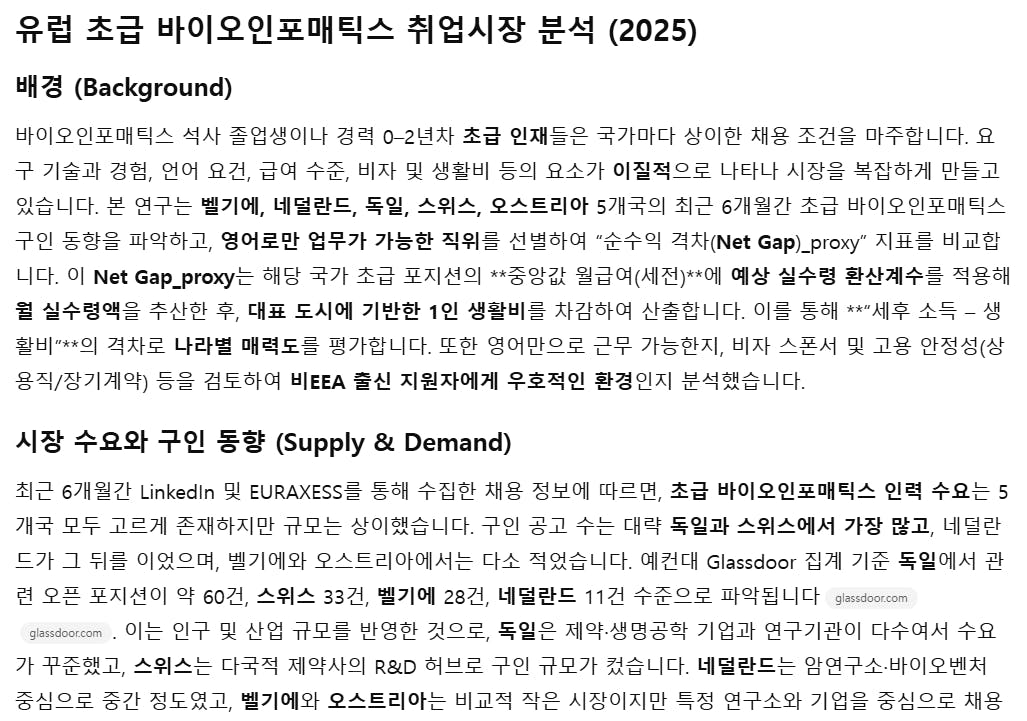
해당 단어가 있는 한국어 페이지
(2) 국가 별 Net Gap 순위 바 차트
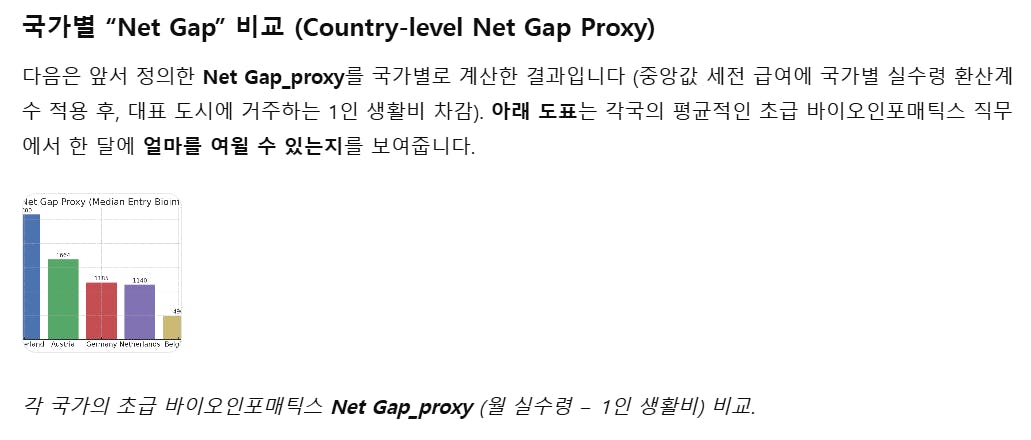
순 격차 국가 수준 순 격차 예측이라는 단어가 포함된 그래프
(3) 데이터 스프레드 시트 (CSV/Google Sheets)
처음에 제공하지 않아 다시 요청했는데, 여전히 CSV 형식이 아니라 줄글 형태의 결과물을 출력한다... (내용도 처음과 거의 동일)
내가 작성한 프롬프트와 실제 결과물을 비교해서 살펴보니, 전반적으로 결과물이 "Expected Outcomes"에 지정한 대로 나오기보다는 "Methodology"에 작성한 내용과 순서 대로 정리되어 나오는 것 같다.
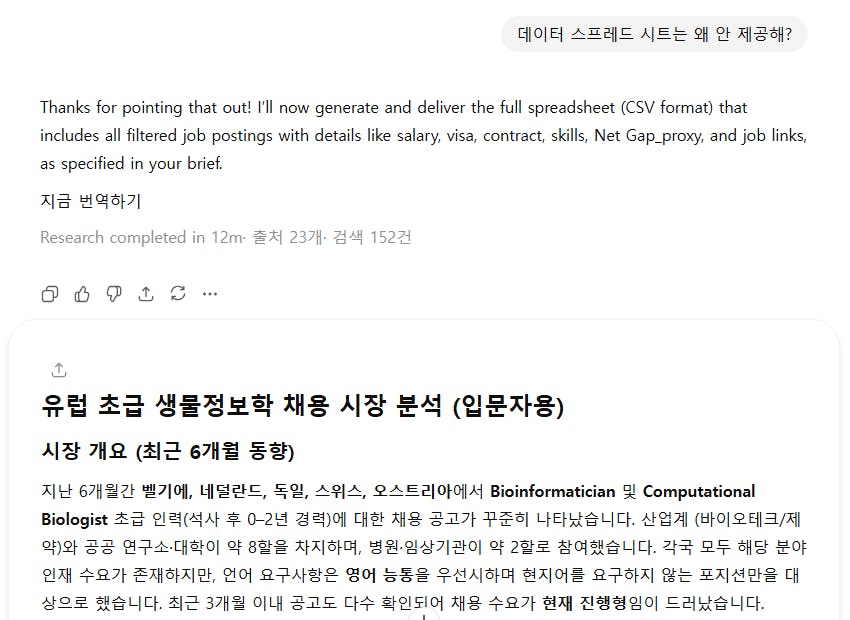
(4) Factor & Cost 요약표
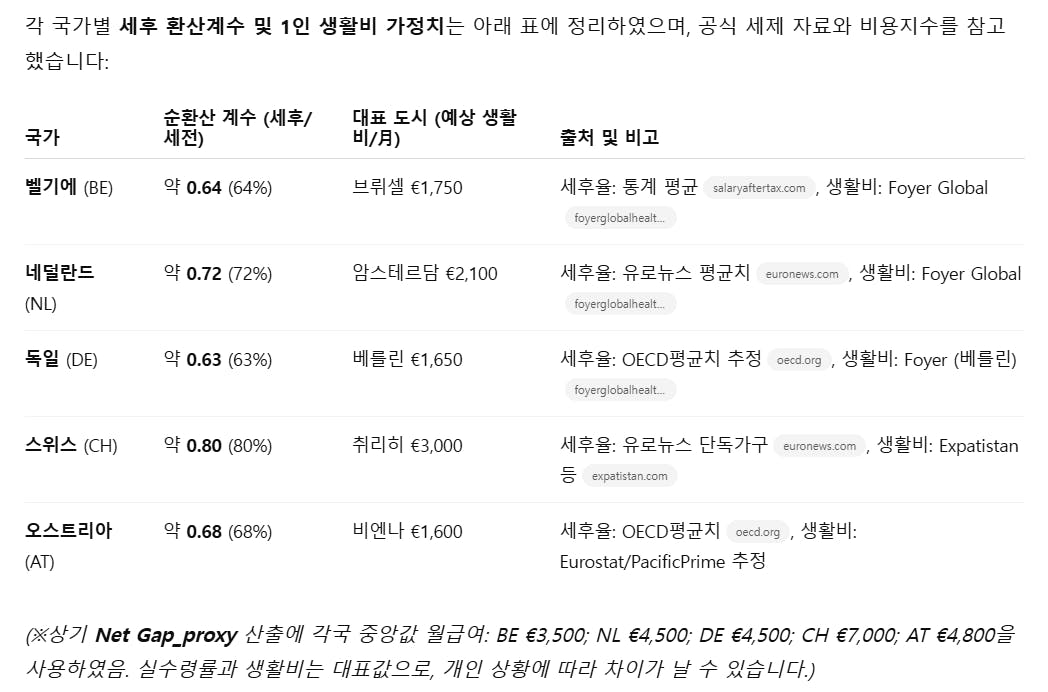
한국어와 영어로 된 이름 목록
그리고 그 외에 Top 5 포지션 추천 등이 정리되어 나왔다. 나는 이 부분에서 현재 진행 중인 특정 공고에 대한 링크를 제공하기를 기대했는데, 그냥 해당 기업을 소개하는 링크가 첨부되어 있는 경우도 많아서 조금 아쉬웠다.
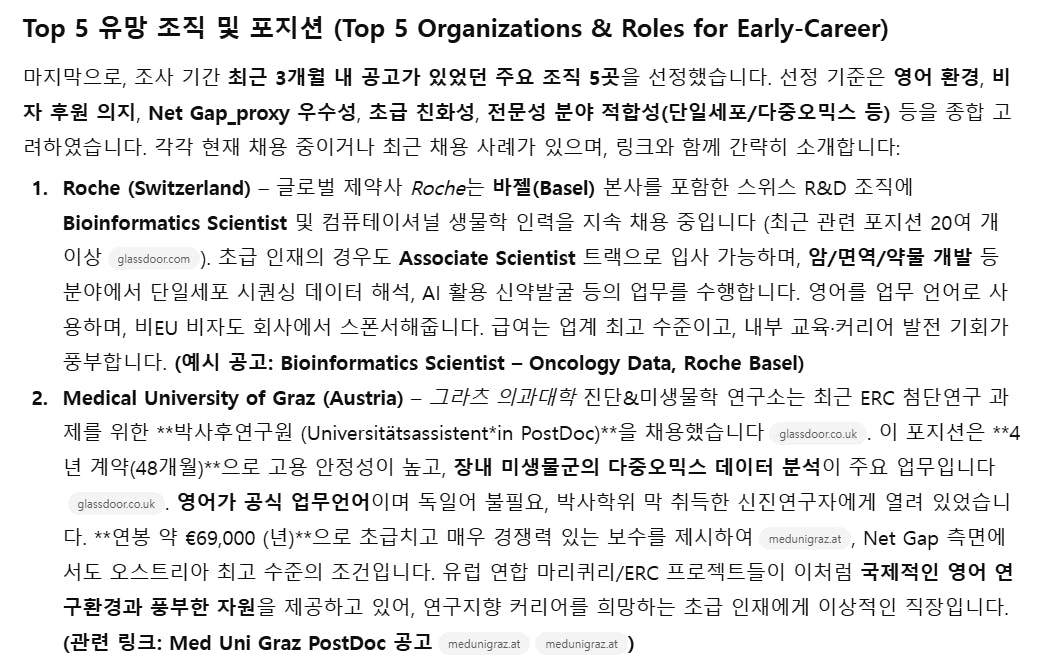
조사한 양이 워낙 방대해서 일부만 캡쳐해서 첨부했는데, 다음에는 출력물을 좀 더 간략하게 요약하도록 만들어도 좋을 것 같다.
📖 배운 점
딥리서치 프롬프트 작성 도우미에서 맥락 강화를 위한 질문에 답하면서 조사 범위가 훨씬 더 명확하고 구체적으로 설정되는 것을 느꼈다. 나라 별 혹은 섹터 별 (산업체, 공공 연구소, 의료 기관 등) 선호도를 비율로 지정하는 부분이 가장 참신했는데, 이 프롬프트를 이용하지 않았으면 혼자서는 생각하기 어려운 부분이었을 것 같다. 좋은 질문을 하는 능력이 그 무엇보다 중요해진 시대라는 것을 느낀다.
검색할 공고는 최근 몇 개월 기준으로 제한할지, 최소 계약 기간은 몇 년으로 정할지 등 정량적인 부분 뿐만 아니라, 연봉과 삶의 질 중 어떤 요소를 더 중시하는지, 어떤 기술 스택에 포커스를 둘지 등 정성적인 부분까지 고려해서 리서치가 가능하다는 게 딥리서치의 큰 강점인 것 같다. 그리고 체감상 정확한 수치보다 지원자에게 주로 요구되는 스킬셋 등 정성적인 부분에 대한 조사가 더 정확도가 높은 것 같다.
한 번에 모든 리서치를 끝내려고 여러 항목들을 모두 조사해달라고 요구했더니 빠진 부분도 보이고 결과물도 만족스럽지 않았다. 조사할 내용이 많을 경우, 파트를 나눠서 단계별로 진행하면 결과물의 퀄리티를 더 높일 수 있을 것 같다. 답변의 내용뿐만 아니라 형식도 마찬가지인데, 위에서 언급한 것처럼 CSV 형식의 데이터 스프레드 시트도 제공하지 않았고, 결과물도 모두 영어로 작성해달라고 했는데 한국어로 작성했다.
아직은 GPT에만 의존해서 리서치를 진행하는 것에는 한계가 있다는 것이 보이지만 (디테일이나 정확도 부족 - 프롬프트를 더 발전시키면 이 부분도 보완 가능할 수도), 초기 단계에서 큰 그림을 그리는 용도로는 아주 좋은 것 같다. GPT가 조사한 결과 중에 "포지션을 찾을 때 이런 부분도 고려해야겠구나" 라고 생각이 들게 하는 내용들도 있어서, 방향성을 잡을 때 도움이 많이 된다.
