


I've been experimenting with AI video generation for short-form content over the past few weeks. My goal wasn't to create cinematic masterpieces—I simply wanted videos that felt natural enough for product demos, social media posts, and quick storytelling.
Like many people, I assumed better results would come from writing longer and more detailed prompts.
After dozens of tests, I realized I was solving the wrong problem.
My First Approach
My prompts usually looked something like this:
A young woman walking through a modern office, cinematic lighting, ultra realistic, 8K quality, highly detailed, professional camera movement, dramatic atmosphere, depth of field...
The generated videos looked decent, but I kept running into the same issues:
Characters changed slightly between scenes.
Camera movement sometimes felt random.
The scene became overly complicated.
Small details distracted from the main subject.
I thought adding more instructions would improve the output.
Instead, it often made the results less predictable.
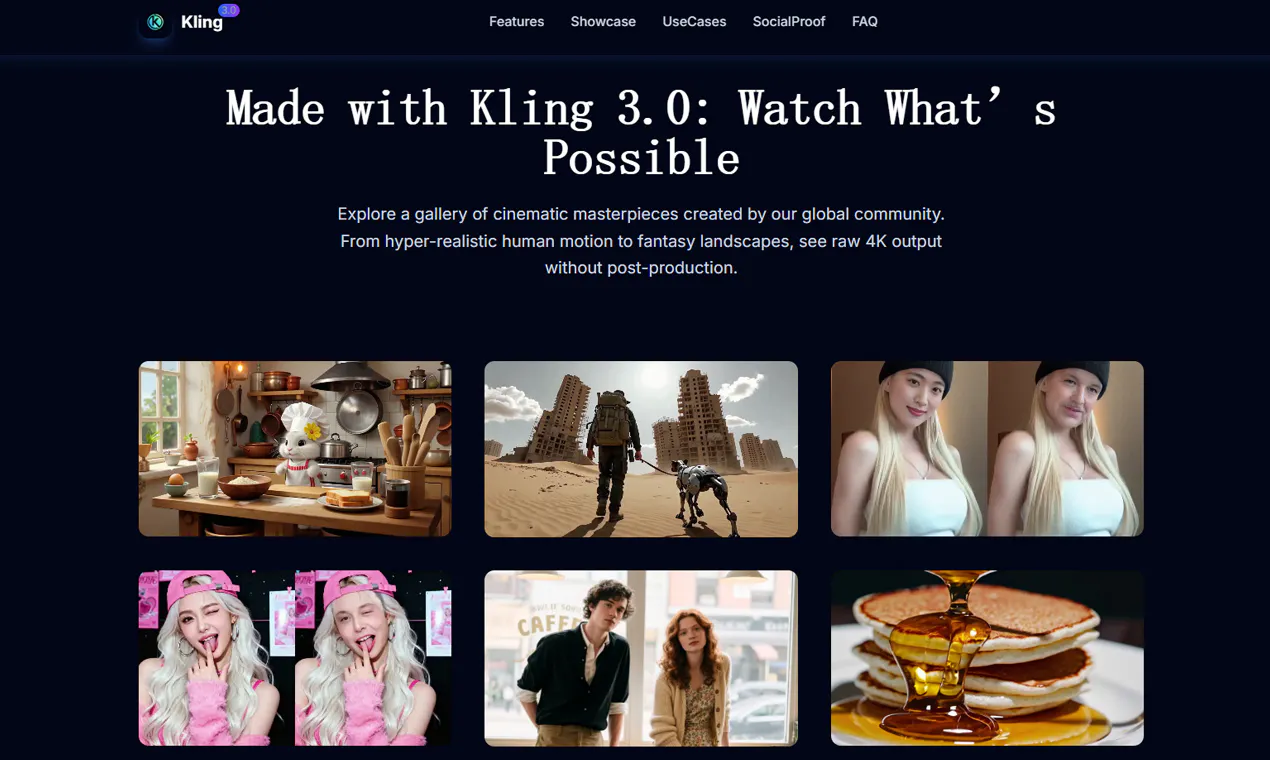
30을 죽이는 것으로 만들어진 웹사이트의 홈페이지 무엇이 가능한지 지켜보세요
What I Changed
Rather than adding more keywords, I started removing them.
Now I keep every prompt focused on four things:
One subject
One action
One environment
One camera movement
For example:
A woman carrying a coffee cup walks slowly through a bright office while the camera gently follows behind her.
That's it.
No long list of cinematic buzzwords.
Surprisingly, the videos became much more consistent.
Another Habit That Helped
Instead of changing five things after every generation, I now adjust only one variable at a time.
For example:
First test: change the camera movement.
Second test: change only the action.
Third test: change only the environment.
This makes it much easier to understand which change actually improves the result.
I also started saving every successful prompt instead of rewriting them from scratch for each new project.
Most of these prompt experiments were organized while testing Kling 3.0, which made it easier to compare different prompt variations and keep my workflow consistent.
My Current Workflow
My process is much simpler now:
Write a short scene description.
Generate the first version.
Check character consistency before anything else.
Modify only one prompt element at a time.
Save successful prompts for future projects.
It isn't a complicated system, but it's much more repeatable than my original approach.
What I Learned
The biggest lesson wasn't finding a "perfect prompt."
It was learning that clear instructions usually outperform complicated ones.
A simple prompt with a clear subject and action often produces better videos than a paragraph full of descriptive keywords.
I'm still experimenting every week, but simplifying my workflow has improved my results far more than constantly searching for new prompt tricks.
I'd love to hear how other people approach AI video generation.
Do you prefer highly detailed prompts, or have you also found that keeping things simple produces more consistent results?